
After lagging behind the broader market over the past three and six months, defence sector stocks have regained ground, reversing their performance from the past month. Concerns about slowing order inflows, execution hurdles, supply chain disruptions, and high valuations had weighed on the sector.

A lower risk appetite among investors has driven gold, traditionally a safe-haven asset, to record highs so far this year. Fuelled by geopolitical tensions in West Asia, robust demand from central banks - particularly in Asia - and US President Donald Trump's tariff volleys, spot gold touched an all-time high of $2,956 per ounce on February 24 in the international markets.

Analysts are warning of growing risks to the market's sustained momentum, and even to the possibility of consolidation at current levels. Domestically, markets are grappling with several challenges, including a slowing economy, as indicated by the latest GDP data for the July-September (Q2) quarter of 2024-25 (FY25), sticky inflation, fluctuations in the rupee, waning consumption, and high interest rates.

Prospects of a bumper kharif harvest are expected to lower food inflation in the coming months, making the country's inflation outlook benign, the Union Ministry of Finance (FinMin) said in its monthly economic report for October released on Monday.

India's stock markets are experiencing a shift in investor sentiment, with a 30 per cent surge in Chinese stocks, prompting investors to move money from domestic markets to China. This reversal of fortunes is a notable change from the past three years, where China's losses benefited India.

All investors should ideally have a 10 to 15 per cent allocation to gold. Whether they invest in gold ETFs or SGBs should depend on their investment horizon.

'Investors with foreign currency-denominated goals, such as foreign education or foreign travel, should go for US equity funds.'

Even a whiff of an incident like the violent 1989 shirt-ripping attack on Krishnamachari Srikkanth by a Karachi spectator would be ruinous. It would set back the ties further, derail an ongoing tournament, and harden Indian attitudes on playing Pakistan anywhere at all, asserts Shekhar Gupta.

'It makes sense to have gold in one's portfolio keeping the political and economic risks of 2024 in mind.'

Six US Congressmen have written to the Attorney General of the United States expressing concerns over the Department of Justice's indictment of the Adani Group, alleging it jeopardizes relations with India. The letter, signed by Lance Gooden, Pat Fallon, Mike Haridopolos, Brandon Gill, William R Timmmons, and Brian Babin, criticizes the Biden administration's decision to pursue the case, arguing that it has no real injury to US interests and could negatively impact the strategic partnership between the US and India. The Congressmen call for an investigation into the DOJ's conduct and request records pertaining to the case.

By taking the mutual fund route, investors can take exposure to gilts with small amounts. Over a decade or more, returns from these funds tend to be sound.

Equity mutual funds witnessed an inflow of Rs 35,943 crore in November, marking a drop of 14 per cent on a month-on-month basis, amid heightened volatility in stock markets driven by various macroeconomic factors, geopolitical events and US election results. Despite this, it marked the 45th consecutive month of net inflows into equity-oriented funds, reflecting the growing popularity of mutual funds among investors, according to data from the Association of Mutual Funds in India (AMFI) released on Tuesday.

'The biggest near-term risk to Indian equities is the outflow of investments to China as tactical trades by foreign investors.'

Another priority in the first 100 days could be the launch of an e-platform -- Trade Connect -- to help exporters connect with stakeholders of international trade.

Novice investors must understand that volatility is an inherent part of equity markets and learn to navigate through such phases.

'Geopolitics will be the most important driver of financial markets in 2025.'

'Challenge is basically near-term growth as the outlook has turned a bit adverse.'

'If gold's recent surge has increased its allocation beyond 15 per cent in your portfolio, now may be a good time to rebalance.'

'Higher interest rates make gold less attractive as it doesn't generate yield.' 'However, with rates set to fall, the tables are turning for gold.'

'Geopolitical risks and their impact on oil prices, if any, are another concern for global markets, particularly for India.'

A fracture of interstate relations could be India's biggest risk coming out of the pandemic. This topped a list of critical risks for India over the next two years, according to Geneva-based World Economic Forum's Executive Opinion Survey (EOS), whose results were released on Tuesday. Other top risks include a debt crisis in large economies, widespread youth disillusionment, failure of technology governance and digital inequality.

'As the global economy undergoes significant transformations in 2025, India's ability to navigate the complexities of trade wars, financial realignments, and emerging blocs will be pivotal,' explain Harsh V Pant and Soumya Bhowmik.
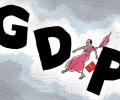
The upcoming Union Budget to be presented on February 1 is likely to assume a nominal gross domestic product (GDP) growth between 10 and 10.5 per cent for FY26, a Business Standard poll of 10 economists showed. The first advance estimates released by the National Statistics Office (NSO) had estimated a nominal GDP growth of 9.7 per cent for FY25. Nominal GDP, calculated at current market prices, factors in the effect of inflation. It is used as the base to calculate crucial macroeconomic indicators, such as fiscal deficit, revenue deficit, and debt-to-GDP ratio.

'If they aim to remain aligned with the public sentiment, as any democratic government should, then they must respond. Why else would the prime minister have cut short his visit to Saudi Arabia? And why would he have instructed the home minister himself to travel to Srinagar to assess the situation firsthand? This suggests that something is indeed being planned. I am quite certain of that, although the exact form it will take remains to be seen.'

The index could be vulnerable to a bigger fall given the present market dynamics.

Challenging the decision of the Biden Administration to investigate the activities of Indian billionaire Gautam Adani and his companies, an influential Republican lawmaker on Tuesday said such selective actions risk damaging critical alliance partners.

Indian economy is in a sweet spot, with a mix of solid growth and moderating inflation, Moody's Ratings said, forecasting a 7.2 per cent GDP growth in the 2024 calendar year and 6.6 per cent in the next. In its Global Macro Outlook 2025-26, the rating agency said the global economy has shown remarkable resilience in bouncing back from supply chain disruptions during the pandemic, an energy and food crisis after the Russia-Ukraine war began, high inflation and consequent monetary policy tightening.

Releasing its annual Global Risks 2014 report, Geneva-based WEF said that the income disparity was the most likely risk to cause an impact on a global scale in the next decade, while other significant risks include extreme weather events, unemployment and fiscal crises.

Retail investors have become a force to reckon with in the last 10 years with their ownership of Indian equities rising 800 basis points, or 8 per cent, to 23.4 per cent during this period, suggests a recent note from Morgan Stanley. This number, Morgan Stanley said, is set to rise in the next few years as Indian households are still underinvested in equities. India's demographics, policy framework, investor education and modest positive real rates, it said, will fuel the 'equity cult' in India.

In a recent note, the global brokerage firm said India now commands a weight of 19 per cent in the above-mentioned portfolio as compared to 18.2 per cent in September 2023. India, it said, is a large liquid market and remains a counter-weight to North Asia if a slowdown in the West occurs and China's recovery disappoints.
He said that the two nations will have issues in the foreseeable future. However, there are ways of addressing those issues and what happened in 2020 was not the way to address those issues.

Former National Security Advisor (NSA) Shivshankar Menon has stated that the political dynamics between India and Pakistan have resulted in a "controlled level of hostility" that benefits the ruling elites in both nations. Speaking at the Kerala Literature Festival, Menon described Pakistan as a "brand new state" still grappling with its national identity. He argued that India's foreign policy towards Pakistan is influenced by its domestic politics, resulting in an uneasy equilibrium characterized by a "controlled level of hostility." Menon also questioned the concept of a multipolar world, stating that the current global order is merely "confused." He emphasized that the United States remains the world's true military hegemon, while other nations, including China, are regional powers. Menon further argued that there is no binding international order, leading to a state of "between orders." He highlighted the absence of definitive international agreements on crucial issues in recent decades.

While India won't be immune to global spillovers, we need to create the macro preconditions for sustained growth. Policy agility, prudence, and resilience will be key, suggests Sonal Varma.

Facing criticism from the government over the central bank prioritising inflation over growth, the new RBI Governor Sanjay Malhotra on Monday said that prospects of the Indian economy are expected to improve on the back of high consumer and business confidence in 2025. "As we strive to preserve financial stability to support a higher growth path for the Indian economy, our focus remains steadfast on maintaining stability of financial institutions and, more broadly, systemic stability," Malhotra said in foreword to the Financial Stability Report.

It will be the second Budget of the Modi 3.0 government and eighth straight Budget for Nirmala Sitharaman, rare in Indian polity.

'While I would never wish for anyone to go through what we are, it has brought out the best in us by making each one of us a better version of ourselves.' 'Being courageous, fighting for freedom, taking the burden of responsibility to help each other...' 'I know hundreds and hundreds of examples where Ukrainians are risking their lives for complete strangers and it is only in moments like this that we truly understand what it means to be human.'

American brokerage firm Morgan Stanley on Thursday sharply cut its India FY23 real GDP growth estimate to 7.9 per cent, mainly due to the impact of the Russia-Ukraine conflict on oil prices. Analysts at the brokerage also raised their inflation forecast to 6 per cent - the upper end of the tolerance band for the RBI - and flagged stagflation risks because of the ongoing events. "We believe that the ongoing geopolitical tensions exacerbate external risks and impart a stagflationary impulse to the economy," they said. It can be noted that stagflation involves a stagnancy in output or growth, coupled with high inflation.

MNC funds invest in companies where foreign promoters have more than 50 per cent shareholding.

The Reserve Bank of India (RBI) has identified "climate shocks" as a risk to food inflation rates and overall price rise while stating that the outlook for the country's economic growth remains bright. In its Annual Report for 2023-24, released on Thursday, the central bank said easing supply-chain pressures, broad-based softening in core inflation, and early indications of an above-normal southwest monsoon meant well for the inflation outlook in 2024-25. "The increasing incidence of climate shocks, however, imparts considerable uncertainty to the food inflation and overall inflation outlook," said the RBI while noting headline inflation moderated by 1.3 percentage points on an annual average basis to 5.4 per cent in 2023-24.

Gold prices slumped for the second straight session by Rs 1,150 to Rs 78,350 per 10 grams in the national capital on Monday on frantic selling by stockists and retailers, the All India Sarafa Association said. The precious metal of 99.9 per cent purity closed at Rs 79,500 per 10 grams on Friday.
 © 2026 Rediff.com - Advertise with us - Disclaimer - Privacy Policy - Sitemap - Feedback - About us - Terms of use - Grievances